manual
Protocol overview
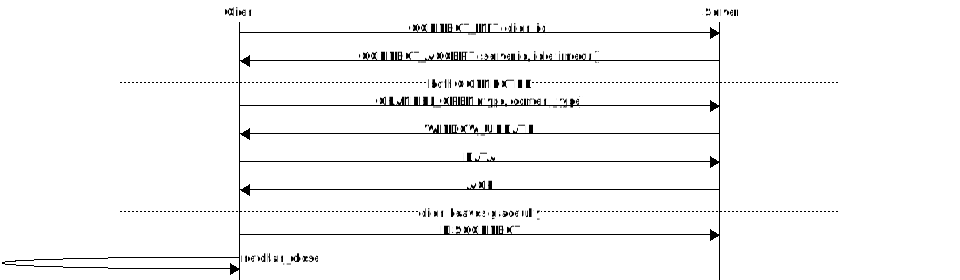
A session begins with a two-message handshake. The client sends a CONNECT_INIT carrying the connection id it chose; the server replies with CONNECT_ACCEPT carrying its own id and the idle timeout it will enforce. Both ends are then CONNECTED and may open channels.
Neither handshake message is acknowledged on its own, so the client drives recovery by retransmitting CONNECT_INIT until it sees the accept. A connected server treats a repeated CONNECT_INIT from its peer as a sign that the accept was lost and re-sends CONNECT_ACCEPT, so a single dropped packet in either direction does not strand the client. The client ignores a second accept once it is connected, and the server ignores an init whose id does not match the peer it already accepted.
A channel opens with a CHANNEL_OPEN frame that names its type and its content type, a short string that labels what the channel carries. The peer answers with a WINDOW_UPDATE that grants send credit. Data then flows as DATA frames, acknowledged by ACK on a reliable channel and left unacknowledged on an unreliable one. When a side leaves, a DISCONNECT frame ends the session at once rather than leaving the peer to notice the silence when the idle timer expires.
Several frames travel in one datagram. A datagram is a small header followed by a run of frames, so a single packet can carry a channel’s data, an acknowledgement for another channel, and a keepalive at once. The protocol reference lists the header and every frame type.